
Self-Managed vs Management Company
Self-Managed HOA Software vs Hiring a Management Company
An honest look at cost, control, transparency, and response time. Software and self-management can mean lower cost and more control; a management company brings hands-on, on-site labor and expertise. Many boards land on a hybrid — and PropMIS is built to run it.
Every board eventually weighs the same decision: run the community yourselves with software, or hand operations to a management company. This is an honest look at the trade-offs — cost, control, transparency, and response time — and where each option genuinely makes sense.
The two ways to run a community
Communities are run in one of two broad ways. In the self-managed model, volunteer board members handle operations directly, increasingly with software that automates dues, payments, communication, and record-keeping. In the outsourced model, the board hires a management company to take on day-to-day operations for a recurring fee. Neither is universally right. The self-managed path keeps costs low and control with the board; the outsourced path trades cost for professional labor and hands-off convenience. Many boards land somewhere in between.
- Self-managed: the board runs operations directly, with software doing the heavy lifting
- Outsourced: a management company handles day-to-day operations for a recurring fee
- Hybrid: boards self-manage with software and bring in help only for specific tasks
What it really costs
Cost is the clearest difference. Industry estimates put management-company fees at roughly $10–$20 per unit per month, up to $50 in higher-cost areas, or 5–12% of monthly dues — and the base rate is often not the whole story. Add-on and markup charges are common: industry fee guides list examples such as annual meeting or election management ($250–$750+ per year), special-meeting attendance ($100–$300 per meeting), setup fees, delinquency legal processing, and early-termination fees. These vary widely by region, size, and scope, and are illustrative rather than a quote. Software replaces much of that recurring labor cost with a predictable, published flat fee: PropMIS is $99/month for up to 10 units, then $3/unit/month after 10 units, with no per-unit management fee.
- Management company: ~$10–$50/unit/mo, or 5–12% of dues, with add-on fees common (industry estimates)
- Common extras: meeting/election management, special-meeting attendance, setup, and early-termination fees
- PropMIS: $99/month for up to 10 units, then $3/unit/month after 10 units
- No surprise platform add-ons for core HOA workflows; online payment processing fees may apply through Stripe.
Control, transparency & response time
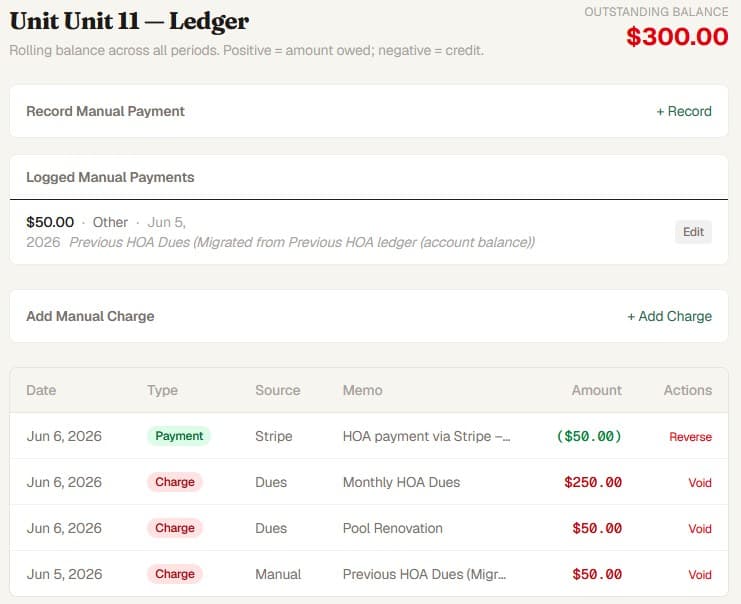
Control and transparency follow the cost pattern. When the board self-manages, every decision, payment, and document stays in the board's hands with a real-time audit trail; when operations are outsourced, visibility depends on the company's reporting cadence and tooling. Response time differs too: a resident question routed through a management company can take days, while self-service software answers many of them instantly. With PropMIS, residents pay dues online, submit requests, view documents, and get AI-powered answers to questions about community rules around the clock — and the board keeps a complete, real-time record of every action.
- Board retains direct control of decisions, finances, and vendor relationships
- Built-in, real-time audit trail of every action for accountability
- 24/7 resident self-service for payments, requests, and documents
- AI answers resident questions about bylaws and policies instantly
Operating like a pro without a management company
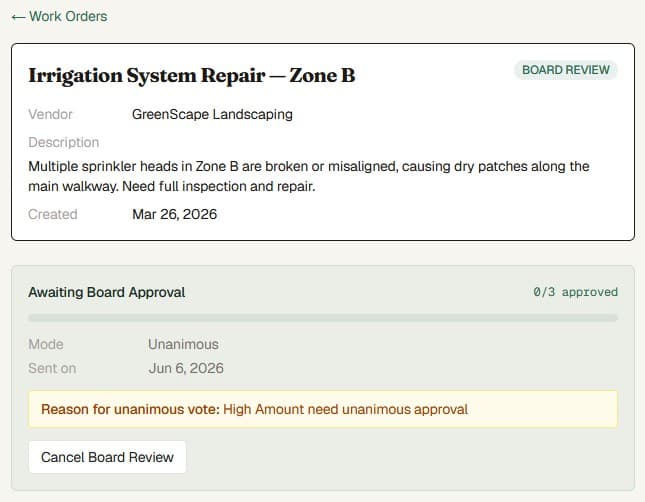
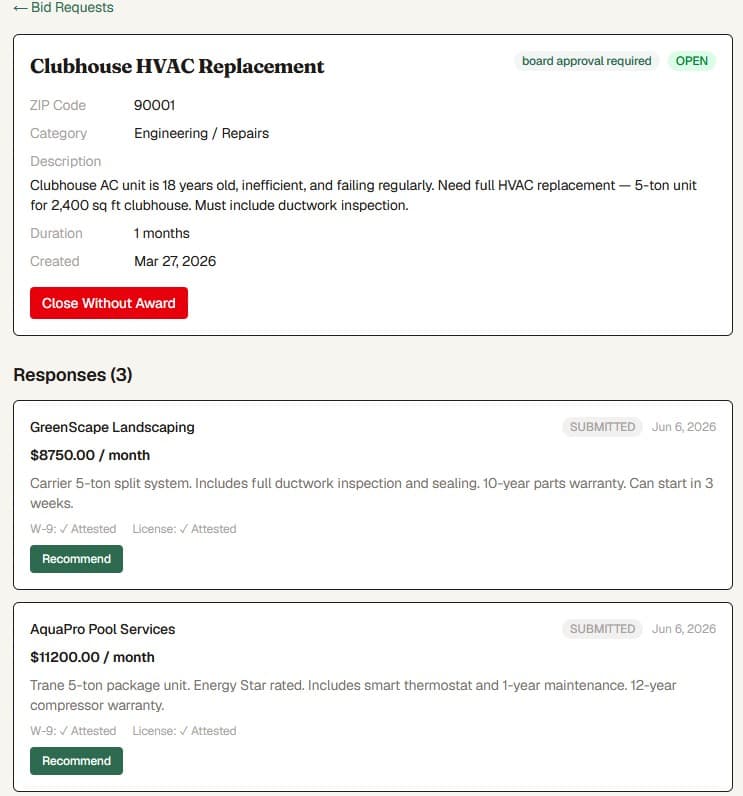
Boards often outsource because they feel they lack the tools or expertise to run things professionally. PropMIS is designed to close that gap. AI assistance gives a volunteer board briefing summaries, plain-language document Q&A, and AI-drafted notices, so a board without dedicated staff can still operate cleanly. The vendor bid marketplace lets a board collect competitive bids on its own — one of the main things a management company's vendor relationships provide — and it is designed to get easier over time: as vendor participation grows, the marketplace can help broaden coverage across service areas and make competitive bidding less manual. And because PropMIS supports community-level manager access — full or read-only, optionally time-limited — a board can keep operations running through volunteer turnover, hand a new treasurer the right access, or give a bookkeeper read-only visibility, all without sharing passwords.
- AI briefings, document Q&A, and AI-drafted notices for boards without dedicated staff
- Vendor bid marketplace for competitive pricing without a management company's relationships
- Community-level full/read-only, optionally time-limited access for continuity through board turnover
- Guided onboarding that gets a volunteer board operational quickly
Where a management company makes sense
Software cannot replace human labor, and for some communities that labor is exactly what is needed. A management company makes sense when a community requires someone to physically attend meetings, answer emergency calls at 2 a.m., walk the property for inspections, manage complex or contentious vendor relationships, or bring professional expertise the board lacks. Larger communities, those with extensive amenities, or boards without the time to self-manage often benefit from outsourcing. The honest framing is not 'software beats management companies' — it is that software handles the systematic, information-driven work, while a management company handles the hands-on, human work. Many boards use PropMIS to self-manage the former and reserve outside help for the latter.
- On-site presence: attending meetings, walking the property, posting notices
- Emergency response and after-hours coverage
- Hands-on vendor management for complex or contentious projects
- Professional expertise for communities that lack it on the board
The hybrid reality
In practice, the choice is rarely all-or-nothing. A growing number of boards self-manage with software to keep dues, records, and resident communication running smoothly, then bring in specialized help only when they need it — a bookkeeper at tax time, or a manager for a major project. This hybrid approach captures most of the cost savings and control of self-management while keeping professional help available for the genuinely hands-on tasks. With community-level access controls, a board can even give that bookkeeper or project manager exactly the access they need and nothing more. PropMIS is built to be the operating system for that model.
- Self-manage the systematic work; outsource only the hands-on tasks
- Keep costs and control with the board while help stays available when needed
- Grant a bookkeeper or project manager scoped access via community-level manager coverage
Self-managed with PropMIS vs a management company
A factual comparison of the two models. Management-company figures are industry estimates as of June 14, 2026 and vary widely by region, size, and scope.
| Feature | PropMIS | Management company |
|---|---|---|
| Best fit | Boards that want control and lower cost, with help available when needed | Communities needing full hands-on, on-site management |
| Typical cost | $99/mo (up to 10 units), then $3/unit/mo | $10–$50/unit/mo, or 5–12% of dues1, 2 |
| Common add-on / hidden fees | No surprise platform add-ons for core HOA workflows; online payment processing fees may apply through Stripe. | Meeting/election surcharges, special-meeting attendance, setup & early-termination fees common1, 2, 3 |
| Board control of decisions | Board retains direct control | Delegated to the company |
| Transparency / audit trail | Built-in, real-time | Varies by company reporting |
| Contract lock-in | Month-to-month | Often contract-based, with early-termination fees3 |
| AI assistance for boards | Included (briefings, doc Q&A, AI-drafted notices) | Depends on the company's tools |
| Competitive vendor bidding | Built-in marketplace, designed to get easier over time as vendor participation grows | Through the company's vendor relationships |
| Continuity / backup access | Community-level full/read-only, optionally time-limited access through board turnover | Provided by the company's staff |
| 24/7 resident self-service | Varies | |
| On-site human tasks (meetings, inspections, emergencies) | Not a software function | |
| Free trial | 45-day free trial, no credit card | Service engagement (no software trial) |
Management-company figures are industry estimates that vary widely by region, community size, and scope of service. They are illustrative, not a quote — verify directly with any provider you consider.
Sources
- 1 iPropertyManagement, HOA Management Fees guide, accessed June 14, 2026. — https://ipropertymanagement.com/guides/hoa-management-fees
- 2 HOAManagement.com, HOA Management Fees, accessed June 14, 2026. — https://www.hoamanagement.com/hoa-management-fees/
- 3 RowCal, HOA management fees — included vs extra, accessed June 14, 2026. — https://www.rowcal.com/news/hoa-management-fees-included-vs-extra/
Comparison based on publicly available information as of June 14, 2026. Management-company fees are industry estimates that vary widely by region, community size, and scope of service — verify current pricing directly with any provider you consider. Figures are illustrative and not a quote.
Frequently Asked Questions
Common questions
How much does a management company cost compared to self-managing with software?
Industry estimates put management-company fees at roughly $10–$20 per unit per month, up to $50 for full-service, or 5–12% of monthly dues, with add-on fees common — for example, annual meeting or election management ($250–$750+ per year), special-meeting attendance ($100–$300 per meeting), and early-termination fees (as of June 14, 2026). Self-managing with PropMIS is $99/month for up to 10 units, then $3/unit/month after 10 units. Actual management-company pricing varies widely — verify directly with any provider.
Can a board really self-manage without a management company?
Many do. PropMIS provides the systems boards need to operate professionally — dues automation, online payments, board approvals, document management, communications, and a permanent audit trail — plus AI assistance and guided onboarding. The board keeps control while the software handles the routine work.
Can a volunteer board keep operations running through board turnover?
Yes. Because PropMIS is the system of record, dues, ledgers, vendor history, and board decisions survive treasurer and board transitions. Community-level manager access — full or read-only, and optionally time-limited — lets a board onboard a new officer or a bookkeeper with exactly the right access, without sharing logins, so operations keep running when volunteers change.
How do self-managed boards handle vendors without a management company?
PropMIS includes a competitive vendor bid marketplace, so a board can post a request, collect bids, and compare them side by side — without relying on a management company's vendor relationships. Over time, as vendor participation grows, the marketplace can help broaden coverage and make competitive bidding easier to repeat. This is an operational advantage, not a guaranteed-savings claim.
When should we hire a management company instead?
When the community needs human labor a tool cannot provide: on-site meeting attendance, emergency and after-hours response, property inspections, hands-on management of complex vendor projects, or professional expertise the board lacks. Larger or amenity-heavy communities often benefit from outsourcing these.
Can we use software and a management company together?
Yes. Many boards self-manage routine operations with PropMIS and bring in specialized help only when needed — a bookkeeper at tax time or a manager for a major project — capturing most of the cost savings and control while keeping professional help available. Community-level access controls let you scope exactly what outside help can see and do.
Are there hidden fees with PropMIS?
No surprise platform add-ons for core HOA workflows; online payment processing fees may apply through Stripe at standard rates.
Ready to modernize your community?
$99/mo per community. 45-day free trial. No credit card required.