
Violation Management
HOA Violation Tracking Software with Board Approvals and Audit Trails
Track violations from initial notice to resolution with board approval workflows, AI-drafted notices, and a complete audit trail.
What HOA Violation Tracking Software Does
Violation tracking software manages the lifecycle of community rule enforcement — from the moment a potential violation is identified to its final resolution. For HOAs, this process involves multiple steps: documenting the violation, drafting a notice, obtaining board approval (when required by governing documents), sending the notice to the resident, tracking the resident's response, and recording the outcome. Without software, this process lives in email threads, word processing documents, and filing cabinets. Notices are drafted inconsistently, approval records are informal or nonexistent, and the board has no centralized way to see which violations are open, which are resolved, and which have been escalated. PropMIS provides a structured workflow for every step, with each action recorded in a permanent audit trail that protects both the board and the resident.
- Structured workflow from violation identification to resolution
- Centralized tracking of all open, pending, and resolved violations
- Board approval workflows ensure due process before notices are sent
- Permanent audit trail documents every action for accountability
- Replaces scattered email threads and paper files with a single system
AI-Assisted Violation Drafting
Drafting violation notices is one of the most time-consuming parts of enforcement for volunteer boards. Each notice needs to reference the relevant rule, describe the specific violation, state the required corrective action, and include a reasonable deadline — all in language that is professional and consistent. PropMIS includes AI-assisted drafting that helps board members and managers create violation notices more efficiently. The AI can generate a draft notice based on the violation type and community rules, which the author then reviews, edits, and approves before it enters the approval workflow. This is not a replacement for human judgment — every AI-generated draft requires review and approval by a board member or manager before it is sent. The goal is to reduce the time spent on initial drafting and improve consistency across notices, especially for boards where different members have different writing styles and levels of experience with enforcement language.
- AI generates draft notices based on violation type and community context
- Every draft requires human review and approval before entering the workflow
- Improves consistency across notices drafted by different board members
- Reduces drafting time for volunteer boards without specialized staff
- Board members retain full control over notice content and tone
Board Approval Workflows
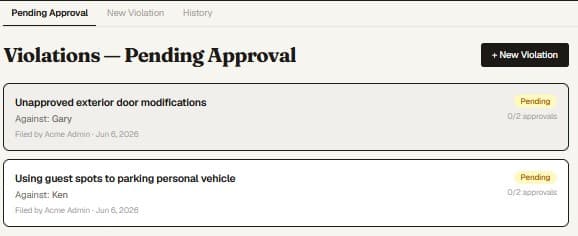
Many HOA governing documents require board approval before violation notices can be sent to residents. PropMIS supports configurable approval workflows that match your community's requirements. You can configure violations to require majority approval, unanimous approval, or a custom approval threshold. When a violation is submitted for approval, board members receive a notification and can review the violation details, the draft notice, and any supporting documentation before casting their vote. The approval process is documented in the audit trail: who approved, who declined, when each vote was cast, and the final outcome. This creates a clear record that the board followed its own procedures — which is important both for resident confidence and for the board's legal protection in the event of a dispute.
- Configurable approval thresholds: majority, unanimous, or custom
- Board members review violation details and draft notices before voting
- Each vote is timestamped and recorded in the permanent audit trail
- Notification system alerts board members when approvals are pending
- Approval documentation protects the board in enforcement disputes
Complete Audit Trails
Every action in the PropMIS violation tracking system is recorded in a permanent, immutable audit trail. When a violation is created, the system records who created it, when, and with what details. When a notice is drafted, reviewed, or edited, those actions are logged. When the board votes on approval, each vote is timestamped. When a notice is sent, the delivery is documented. When a resident responds, the response is recorded. And when a violation is resolved — whether through compliance, waiver, or escalation — the resolution is documented with the reason and the person who closed it. This audit trail serves multiple purposes. It provides accountability for boards, demonstrating that enforcement was conducted through a consistent, documented process. It provides transparency for residents, who can see the status and history of violations associated with their unit. And it provides protection for the association in the event that enforcement decisions are challenged, because every step is documented with timestamps and attributable actions.
- Every action logged with timestamp, actor, and details
- Violation creation, drafting, approval, delivery, and resolution all tracked
- Immutable record — entries cannot be edited or deleted after creation
- Demonstrates consistent enforcement process in the event of disputes
- Accessible to authorized board members and managers for review at any time
Resident Visibility and Communication
PropMIS gives residents visibility into violations associated with their unit through the branded resident portal. When a violation notice is issued, the resident can see the notice, the specific rule referenced, the required corrective action, and the deadline. Residents can respond to violations directly through the portal, providing explanations, requesting extensions, or confirming that corrective action has been taken. This two-way communication channel reduces the back-and-forth that typically happens over email or phone and creates a documented record of the resident's response. The goal is to make the enforcement process feel fair and transparent rather than adversarial. When residents can see exactly what is expected of them, when it is due, and how to respond, compliance rates improve and the emotional friction around enforcement decreases. Early-access communities using PropMIS have noted that structured communication reduces the volume of informal complaints and board meeting confrontations related to violations.
- Residents see violation notices, referenced rules, and deadlines in their portal
- Resident responses are submitted through the portal and documented automatically
- Two-way communication replaces informal email and phone exchanges
- Transparent process reduces adversarial dynamics around enforcement
- $99/mo per community + $3/unit over 10 — violation tracking included with all features
Frequently Asked Questions
Common questions
Does PropMIS track the full violation lifecycle?
Yes. PropMIS tracks violations from initial identification through drafting, board approval, notice delivery, resident response, and final resolution. Every step is documented in a permanent audit trail.
Can the AI draft violation notices automatically?
The AI generates draft notices based on the violation type and community context, but every draft requires review and approval by a board member or manager before it enters the approval workflow. The AI assists with drafting — it does not send notices autonomously.
What approval options are available for violation notices?
PropMIS supports configurable approval workflows including majority, unanimous, and custom thresholds. You configure the approval requirement to match your governing documents.
Can residents respond to violations through the platform?
Yes. Residents can view violation notices and submit responses through their branded portal. Responses are documented automatically and visible to authorized board members and managers.
How much does PropMIS cost?
PropMIS costs $99/mo per community, plus $3/mo per unit over 10. All features — including violation tracking, AI-assisted drafting, board approvals, and audit trails — are included. 45-day free trial, no credit card required.
Ready to modernize your community?
$99/mo per community. 45-day free trial. No credit card required.