
PayHOA Alternative
PayHOA Helps Run an HOA. PropMIS Helps You Run More Communities.
PayHOA can be a solid fit for smaller HOAs that need basic payments, documents, violations, and accounting. PropMIS is built for managers who need AI briefings, AI-drafted notices, vendor bids, real work orders, per-unit ledgers and audit trails, flexible manager coverage, and a mobile-responsive resident portal.
If your communities mainly need dependable dues collection, PayHOA may be all you need. But if you manage multiple communities and the real cost is your time, PropMIS is designed to reduce manual work and keep operations moving — at $99/month for up to 10 units, then $3/unit/month after 10 units.
When PayHOA starts to feel limiting
PayHOA does the core job of running a single HOA well. The strain tends to show up as a management company grows — when one person is responsible for several communities, and the software stores records but does little to reduce the work of running them. If the situations below sound familiar, the question is no longer whether your tool collects dues; it is whether it helps you operate at scale.
- Managing more than one community and repeating the same setup and workflows each time
- Vendor requests, bids, work orders, and invoices living across email and spreadsheets
- Board packets taking too long to prepare before each meeting
- Residents asking the same document, dues, and policy questions over and over
- Needing audit trails and cleaner context before board meetings
- Needing coverage when a manager is on vacation, overloaded, or transitioning work
- Wanting software that reduces manager workload, not just stores HOA records
Where managers run into PayHOA's limits
PayHOA is generally well-reviewed for ease of use and dependable payments. But on review sites, some PayHOA users report gaps that matter most to managers running at scale. These are user-reported experiences from third-party review platforms, not official PayHOA statements, and capabilities change — verify current details directly with PayHOA.
- On review sites, PayHOA users report no native mobile app
- On review sites, PayHOA users report needing workarounds to invoice vendors (such as creating placeholder units)
- On review sites, PayHOA users report limited propagation of templates and settings across multiple client accounts
- On review sites, PayHOA users report CSV export and bank-reconciliation friction
- On review sites, PayHOA users report glitches editing transactions and templates after submission
What PropMIS adds on top of the basics
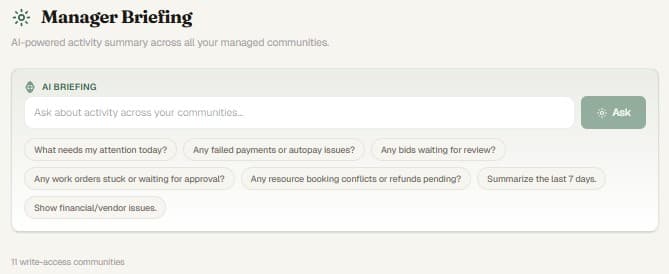
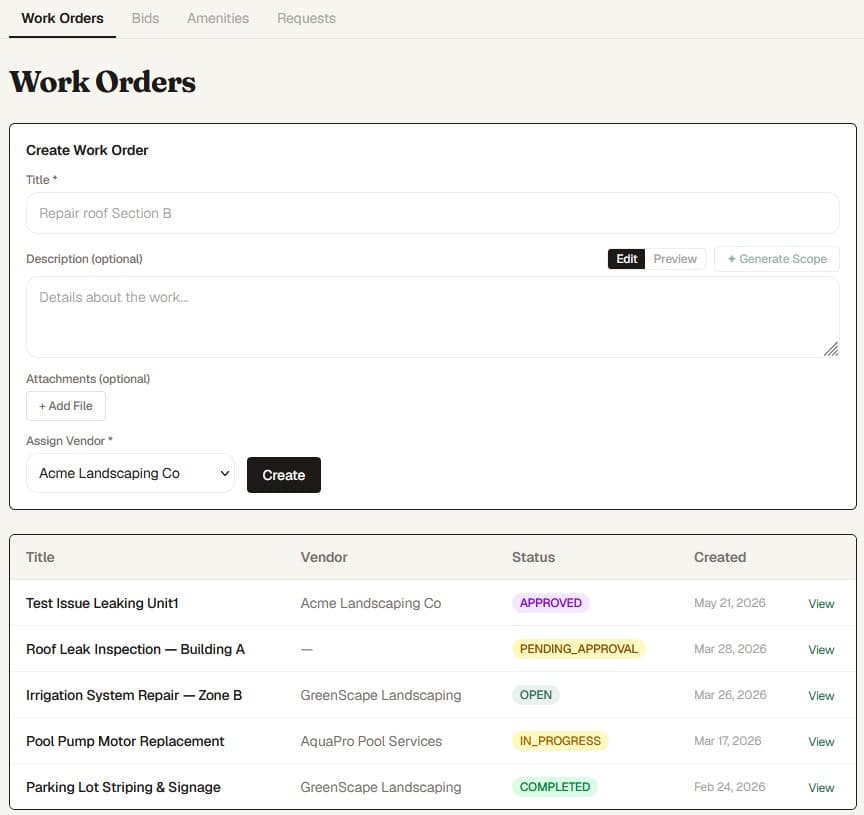
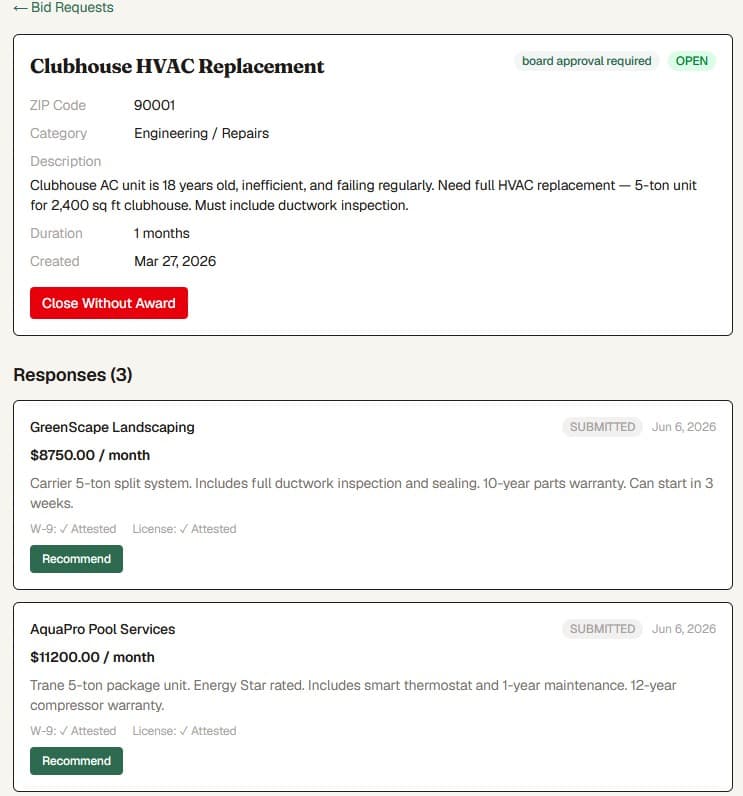
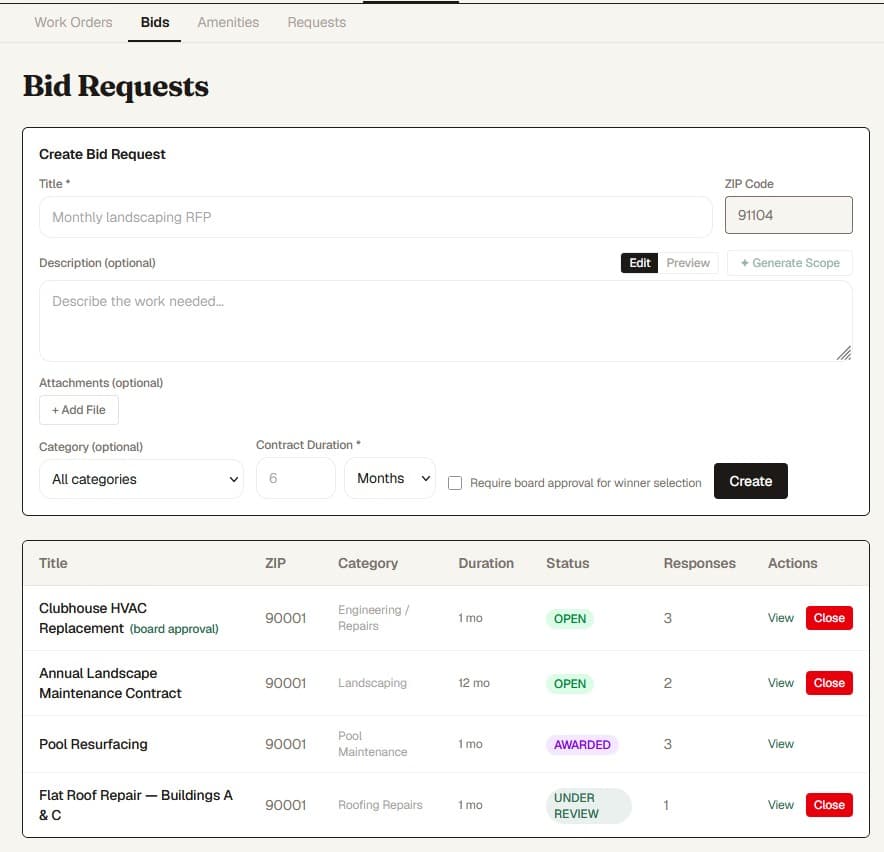
PayHOA and PropMIS both handle the fundamentals — dues, online payments, owner portals, violations, and reporting. PropMIS goes further in three areas that compound for managers: AI woven through every workflow, vendor coordination, and manager coverage. Residents get plain-language answers from governing documents; managers get AI briefings and AI-assisted drafting; and vendor bids, work orders, and invoices live in one workflow instead of scattered email threads. Manager coverage matters, too: when one manager is out, another manager should be able to step in with the right community access, ledger history, vendor context, and board records — without sharing passwords or rebuilding context from email. And vendor bidding is designed to get easier over time: instead of rebuilding vendor lists community by community, managers reuse vendor records, work orders, and bid requests in one place. As vendor participation grows, the marketplace can help management companies broaden coverage across service areas and make competitive bidding less manual.
- AI assistant with document Q&A for residents on bylaws, CC&Rs, and policies
- AI manager briefings and AI-assisted drafting for notices, announcements, and work orders
- Competitive vendor bid marketplace with work orders and invoicing in one workflow
- Community-level manager access — full or read-only, optionally time-limited — so a backup manager can step in
Does the extra cost pay for itself?
For a manager, the question is not only monthly software cost. It is whether the software helps one person manage more work without adding headcount — and whether another manager can step in when coverage is needed. The difference is roughly a few dollars a day for many communities. If better vendor comparison, cleaner board packets, AI-drafted notices, and faster manager workflows prevent even one avoidable mistake or help secure one better bid, the higher plan can be easy to justify. It is not about adding software for the sake of software. It is about reducing manual work, improving transparency, and giving boards and managers better tools to make decisions. Vendor bidding is part of that picture: it is not only about one work order — over time, a marketplace model can help management companies expand vendor coverage, request bids more consistently, and reduce the manual effort of finding, emailing, and comparing vendors for each community.
- Reduce manual, repetitive work across multiple communities
- Improve board and resident transparency with a built-in audit trail
- Better decision tools: AI briefings, side-by-side bids, and per-unit ledger context
- Coverage-ready operations when a manager is on vacation, overloaded, or transitioning
Core HOA tools both platforms share
If your priority is dependable dues collection and resident self-service, both platforms deliver. PayHOA is a mature product with a long track record, and PropMIS matches it on the essentials — online payments, per-unit ledgers, violation tracking, document storage, and communication tools — while layering on AI, vendor coordination, and manager coverage. The decision is less about whether the basics are covered and more about how much you need the software to reduce manager workload.
- Online dues payments and per-unit ledgers on both platforms
- Violation tracking and maintenance requests on both platforms
- Owner portal, document storage, and communication tools on both platforms
Which one fits your community
Both are honest choices. PayHOA's lower entry tiers may suit very small communities focused on dues collection, and it offers optional human bookkeeping and tax-filing services some boards prefer to outsource. PropMIS is optimized for property managers who need to scale operations across communities — AI-assisted workflows, vendor bidding, real work orders, audit trails, and manager coverage built into one system. If you run a single small community on a tight budget, PayHOA may be the better fit; if your constraint is manager time across a growing portfolio, PropMIS is built for that.
- PayHOA may fit very small or price-sensitive communities, with optional human bookkeeping and tax-filing services
- PropMIS fits managers scaling across communities who want AI, vendor bidding, and manager coverage included
Pricing in context
PayHOA prices by unit-count tier, starting at $49/month for 0–25 units on annual billing and rising through its tiers as communities grow; it also offers optional bookkeeping from $199/month. PropMIS prices at $99/month for up to 10 units, then $3/unit/month after 10 units, with AI, vendor bidding, and manager coverage included. For a small community focused purely on dues collection, PayHOA's entry tier may cost less; for managers who need to do more per community, those capabilities are included in the PropMIS plan rather than assembled separately. No surprise platform add-ons for core HOA workflows; online payment processing fees may apply through Stripe.
- PropMIS: $99/month for up to 10 units, then $3/unit/month after 10 units — AI, vendor bidding, and manager coverage included
- PayHOA: unit-tiered pricing starting at $49/month for 0–25 units (annual), with optional bookkeeping from $199/month
- No surprise platform add-ons for core HOA workflows; online payment processing fees may apply through Stripe.
PayHOA vs PropMIS at a glance
A factual, sourced comparison for property managers. Pricing reflects each provider's published rates as of June 14, 2026.
| Feature | PropMIS | PayHOA |
|---|---|---|
| Best fit | Managers scaling operations across communities | Smaller HOAs needing low-cost basics |
| Multi-community manager workflow | Users report limited cross-account templates2 | |
| Manager access / vacation coverage | Community-level manager access with full/read-only patterns and optional time-limited access, so another manager can step in when coverage is needed | Not emphasized in published PayHOA pricing/materials reviewed; verify current role/access controls with PayHOA |
| AI manager briefings | ||
| AI document Q&A | ||
| AI-drafted notices & work orders | ||
| Competitive vendor bid marketplace | Built-in vendor bid requests and marketplace workflow designed to make bid collection simpler over time as vendor participation grows | No published vendor bid marketplace found in materials reviewed; verify current capabilities with PayHOA |
| Vendor work orders & invoicing | Built-in (real vendor records) | Users report workarounds needed2 |
| Board packet / decision support | AI briefings, per-unit ledger context, vendor bid comparison, and audit trail | Core HOA records and reports; no published AI briefing workflow found |
| Mobile access | Mobile-responsive web app | Users report no native mobile app3 |
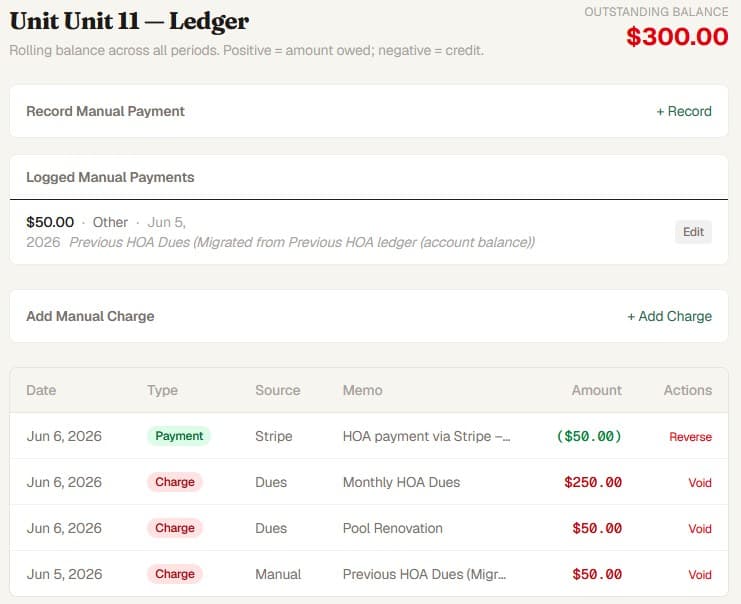
| Accounting / ledger / audit trail | Per-unit ledger + audit trail | Core accounting; users report CSV/reconciliation friction2 |
| Online payments / AutoPay | Stripe + AutoPay | |
| Violation tracking | ||
| Starting price | $99/mo (up to 10 units), then $3/unit/mo | $49/mo for 0–25 units (annual)1 |
| Platform / processing fees | No surprise platform add-ons for core HOA workflows; online payment processing fees may apply through Stripe. | Payment processing fees apply (ACH $2.45, card 3.5% + $0.50)1 |
| Optional human bookkeeping service | Not offered | From $199/mo1 |
| Free trial | 45-day free trial, no credit card | 30-day free trial, no credit card1 |
Rows marked 2 and 3 reflect experiences reported by PayHOA users on third-party review sites, not official PayHOA statements. Capabilities change — verify current details directly with PayHOA.
Sources
- 1 PayHOA pricing page, accessed June 14, 2026. — https://www.payhoa.com/pricing/
- 2 PayHOA reviews on Capterra, accessed June 14, 2026. — https://www.capterra.com/p/146693/PayHOA/reviews/
- 3 PayHOA reviews on SoftwareAdvice, accessed June 14, 2026. — https://www.softwareadvice.com/product/61833-PayHOA/
Comparison based on publicly available information as of June 14, 2026. Competitor pricing, features, and plans change frequently — verify current details directly with each provider before making a decision. PropMIS is not affiliated with, endorsed by, or sponsored by any company named on this page; all trademarks belong to their respective owners.
Frequently Asked Questions
Common questions
How is PropMIS different from PayHOA?
Both cover core HOA tasks like dues, payments, portals, and violations. PropMIS adds AI woven through every workflow — document Q&A, manager briefings, and AI-assisted drafting — plus a competitive vendor bid marketplace and community-level manager coverage, which help managers run more communities with less manual work.
Can another manager cover a community when the primary manager is out?
Yes. PropMIS is designed for property management teams that need community-level manager access instead of shared logins or email handoffs. A backup manager can be given the right level of access — full or read-only, and optionally time-limited — so they can review ledger history, vendor work, board records, and resident context when the primary manager is unavailable. This is especially useful for vacations, staff transitions, or overloaded portfolios.
How does the PropMIS vendor marketplace help property managers?
PropMIS is designed to reduce the manual work of finding vendors, requesting bids, tracking responses, and comparing options across communities. Over time, as vendor participation grows, the marketplace can help management companies broaden their service coverage and make competitive bidding easier to repeat. This is an operational advantage, not a guaranteed-savings claim.
Is it easier to start a new community on PayHOA or PropMIS?
PayHOA may be a straightforward option for a smaller HOA that wants to quickly start with basic payments, units, requests, violations, reports, and communications. PropMIS is designed for a different starting point: a property manager onboarding a community into a repeatable operating system. With PropMIS, the goal is not only to create the community record — it is to set up the ledger, resident portal, manager access, vendor workflow, board context, audit trail, and AI-ready documents so the community is easier to operate after launch. That matters when a management company is onboarding multiple communities or needs another manager to step in during vacations, transitions, or overloaded portfolios.
Is switching from PayHOA worth the disruption?
Not every HOA should switch. If PayHOA is working and the community mainly needs low-cost basics, staying may make sense. PropMIS makes more sense when the pain is manager workload, vendor coordination, board prep, multi-community oversight, manager coverage, AI-assisted workflows, and transparency.
Is PropMIS worth the extra cost over PayHOA?
The price difference is roughly a few dollars a day for many communities. PayHOA prices by unit tier starting at $49/month for 0–25 units on annual billing (as of June 14, 2026); PropMIS is $99/month for up to 10 units, then $3/unit/month after 10 units, with AI, vendor bidding, and manager coverage included. If those capabilities prevent one avoidable mistake or help secure one better bid, the higher plan can be easy to justify. Verify current PayHOA pricing directly with PayHOA.
How do the PropMIS and PayHOA free trials compare?
Both platforms offer a no-credit-card trial. PropMIS gives managers 45 days instead of 30, which can give more time to test onboarding, ledger setup, resident workflows, manager coverage, AI briefings, and vendor bid workflows before deciding. PayHOA's pricing page states a 30-day free trial with no credit card required and cancel anytime (as of June 14, 2026).
Does PayHOA have a mobile app?
On review sites, PayHOA users report that it lacks a native mobile app as of June 14, 2026; these are user-reported experiences, not official PayHOA statements. PropMIS is fully mobile-responsive. Verify current PayHOA capabilities directly with PayHOA.
When might PayHOA be the right fit?
PayHOA may be the better fit for very small communities, price-sensitive boards, communities that want optional human bookkeeping, or teams already happy with PayHOA's current workflow.
Ready to modernize your community?
$99/mo per community. 45-day free trial. No credit card required.